Netflix’s Advertising Ambitions

Consumers are feeling the pain of inflation. Yesterday, AT&T reported that its wireless customers are having trouble paying their bills on time. On its earnings call, CEO John Stankey noted:
And when you see 9% inflation, it tends to hit those in the low end of the market really, really hard. And it's difficult when you walk up to the gas pump and have to fill the car, and you get the electric bill coming in and you see the kind of step-ups that people are seeing. And I think there's an adjustment period that goes on.
[…]
But there is a portion of the base that clearly is starting to adjust to this dynamic that there's higher calls on their cash in any given quarter. And they're having to adjust between patterns and behaviors and prioritization of how they order bills. And I think we're seeing that there's a little bit of that starting to occur.
When the cost of living goes up, cheaper entertainment becomes more valuable. And Netflix aims to deliver. On Tuesday, during its Q2 earnings call, Netflix confirmed some details of its lower-priced ad-supported tier.
Netflix thinks it can make more money per member (what it calls ARM, or Average Revenue per Member) through an ad tier than it does through its current subscription product.
Here’s the comment from Netflix COO Greg Peters:
And when we run the models and talking to brands, advertisers to Microsoft, we look at the monetization that is the complement to that sort of subscription part of the ad-supported offering, and we're quite optimistic that the sort of unit economics work to make that monetization sort of equal or maybe even better than what we would see on the comparable side for the non-ad, subscription-only kind of plans. So we think that this is, again, expansive from a member reach perspective but also neutral to positive on the unit economics and monetization. So that's great for us for—obviously from a business perspective.
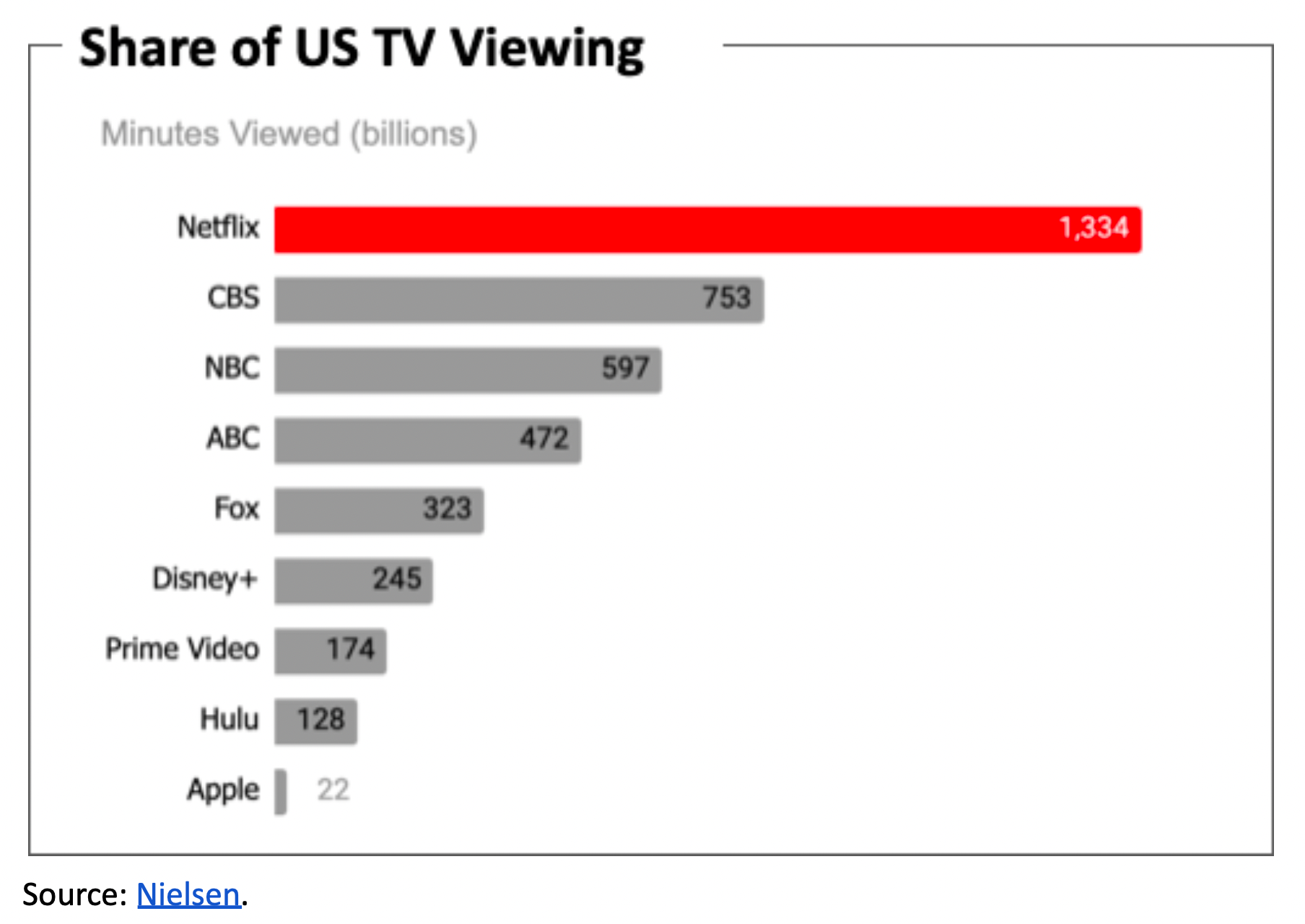
Netflix also showed off its share of US TV viewing in minutes. Even though this is still only 7.7 percent of all TV viewing in the US, it dwarfs its competitors in broadcast and streaming:
When it comes to advertising, therefore, Netflix has promise. But it won’t be quick.
Netflix doesn’t have the in-house experience, technology, or team to develop an ad product, so it interviewed various potential partners and chose Microsoft, which is reportedly giving Netflix a minimum revenue guarantee “in the billions.”
That’s right: Netflix is considered such a catch, Microsoft is willing to lose money initially—since it will take time to ramp up Netflix’s advertising product—to land it as a customer. (Netflix also considered Google, but it’s offer was reportedly “underwhelming.”)
Perhaps, as some have speculated, Microsoft’s motivation is to use Netflix to increase Microsoft’s own advertising capabilities (for use in gaming, for instance), or to lure Netflix as a cloud customer away from AWS and onto Azure.
Strategically, Netflix’s decision to offer an ad-supported tier is a no-brainer, and one wonders what took the company so long. Many analysts believe it’s a mistake to offer ads at all, since it cheapens Netflix’s brand image.
The reality is that streaming has become a very competitive business with low barriers to entry (Quibi and Roku being recent entrants) yet high barriers to scale, and even higher barriers to profitability.
Still, there are plenty of already-scaled competitors, and to the extent they offer ad-supported tiers, they become lower-cost alternatives to Netflix. Three years ago Hulu disclosed it already had 82 million viewers and that 58 million of those, or 70 percent, preferred Hulu’s ad-supported tier. At a time of high inflation and penny-pinching consumers, not having an ad-supported tier becomes a liability.
In Netflix’s case, this liability has wiped out 63 percent of the company’s market value this year after it bled 1.1 million subscribers in the first half of 2022. This loss of $170 billion in market value could have been avoided, or reduced, had Netflix created an ad tier sooner.
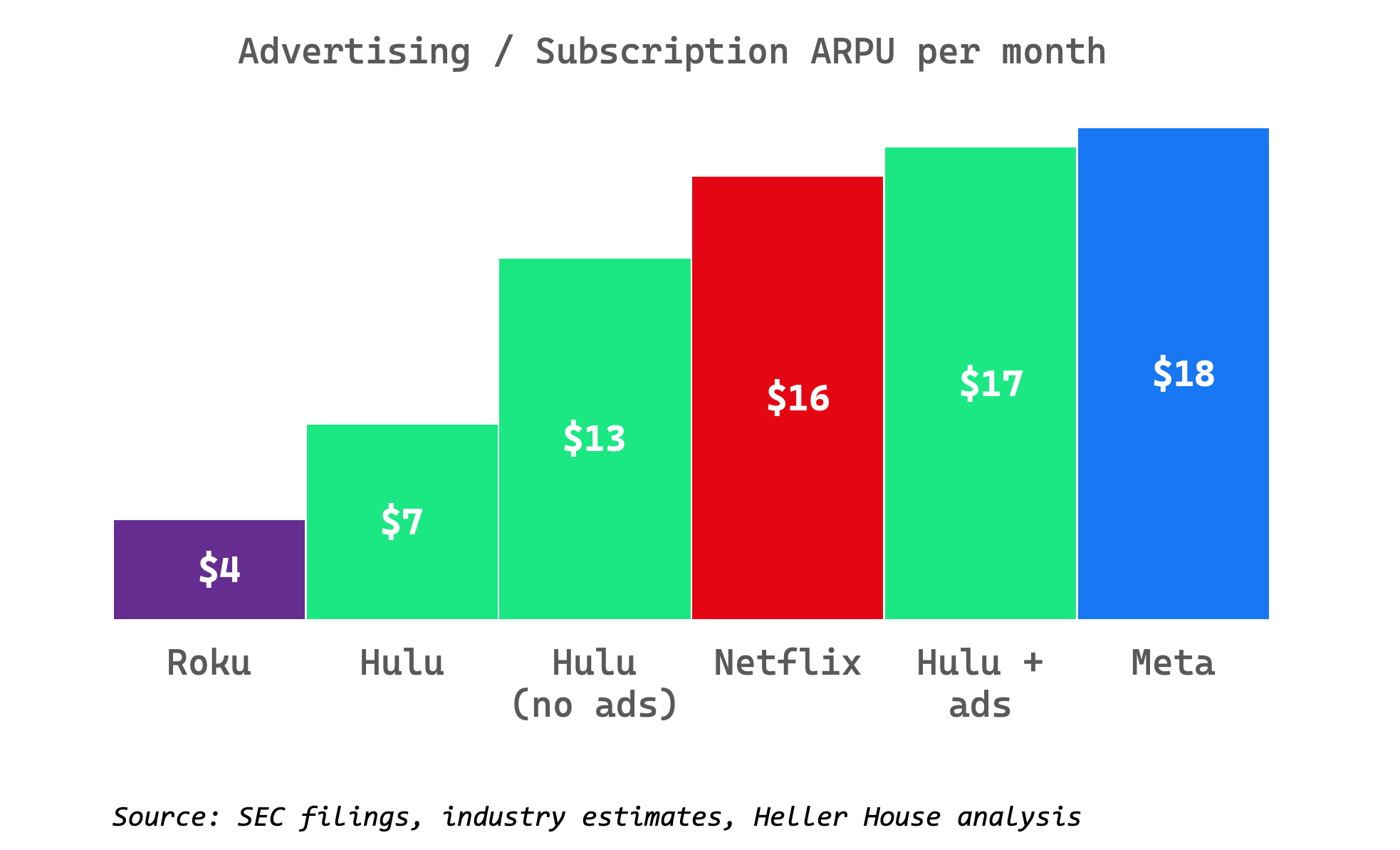
Currently, the ARM (average revenue per member) in the US and Canada (UCAN) region, Netflix’s most profitable, is about $16 per month. If consumers could simply trade down to ad-supported tier instead, they could keep enjoying Netflix, and Netflix could keep making money.
Which brings us back to Peters’s assertion above that the ad tier could be “equal or maybe even better than what we would see on the comparable side for the non-ad, subscription-only kind of plans.”
Could it really?
Below is a comparison of Netflix’s current ARM to what other businesses earn. On the left is Roku, a pure-play ad-supported streaming business with 61 million active accounts in the US. Netflix, in comparison, has 73 million subscribers in its UCAN region.
Roku, which spun off from Netflix, has been working hard at ad-supported streaming for years. It even has a third share of all new TVs sold in the US, the so-called Roku TVs, with its own proprietary operating system. It has developed the muscle and technology to lure advertisers and measure results. While the company does not report CPMs (how much it charges per thousand impression), reports say Roku’s CPM is around $20.
Roku’s ARPU has been growing briskly; in its Q1 earnings report Roku reported 34 percent ARPU growth from the year before. It still has some work to do to bridge the gap with competitors.
Hulu offers two subscription options: $6.99 for Hulu with ads and $12.99 for Hulu without ads. Hulu is reported, however, to earn as much as $10 per subscriber in ad revenue. If that’s the case, Hulu including ads would earn $17 per subscriber, placing it between Netflix and Meta.
I included Meta (Facebook) in the chart above because it shows just how profitable a pure ads business can be. Social networks are only valuable if everyone you know is on them, and this precludes any type of paid revenue model. It was Mark Zuckerberg’s vision from day one to connect the entire world, and the only way to fund this vision is through advertising. Over the last twelve months, Meta earned $18 per monthly active user in its US and Canada segment.
According to Variety, “Morgan Stanley estimated that Netflix could charge $10/month in the U.S. for the ad-based plan, which could generate $7/month per subscriber in ad revenue.” This estimate might be backwards: perhaps Netflix could charge $7/month for the ad-based plan and earn north of $10/month (or at least what Hulu is reported to earn) in ad revenue. This would validate Peters’s claim that Netflix could earn more through its ad-supported tier than it currently does through subscription revenue alone.
In contrast to Roku’s $20 CPM, Netflix is reportedly aiming for $50. Higher CPMs would be justified by Netflix’s unsurpassed content roster, supported by $17 billion in yearly content spending. Sources say that Netflix is aiming at a low ad load with pre- and post-roll ads and nothing else. This would make Netflix’s ad load potentially lower than competitors, and therefore a better user experience.
Some analysts think Netflix has a $4 billion revenue opportunity in a domestic ad-supported tier. This would be a 13 percent increase to Netflix’s overall $30 billion in revenue, but it would also flow through to the bottom line at a very high margin, potentially multiplying Netflix’s meager free cash flows (the company expects $1 billion in free cash flow this year).
While Microsoft lured Netflix with a minimum guarantee, there’s no question Netflix will have to pay Microsoft in the back end. But it’s an effort worth pursuing. When it comes to strategic choice, Netflix doesn’t have a better one than going full steam ahead with the ad tier.