Unity: Doesn’t Add Up
This is a follow-up to yesterday’s post on the Unity/ironSource merger announcement.
The most two most salient points I’d like to examine today are the 2024 EBITDA guidance Unity provided and Unity’s leadership. Let’s take a closer look at both.
Below are revenue estimates for Unity and ironSource, from Bloomberg sell-side estimates, as of this morning. Revenue and EBITDA numbers are in millions of dollars:
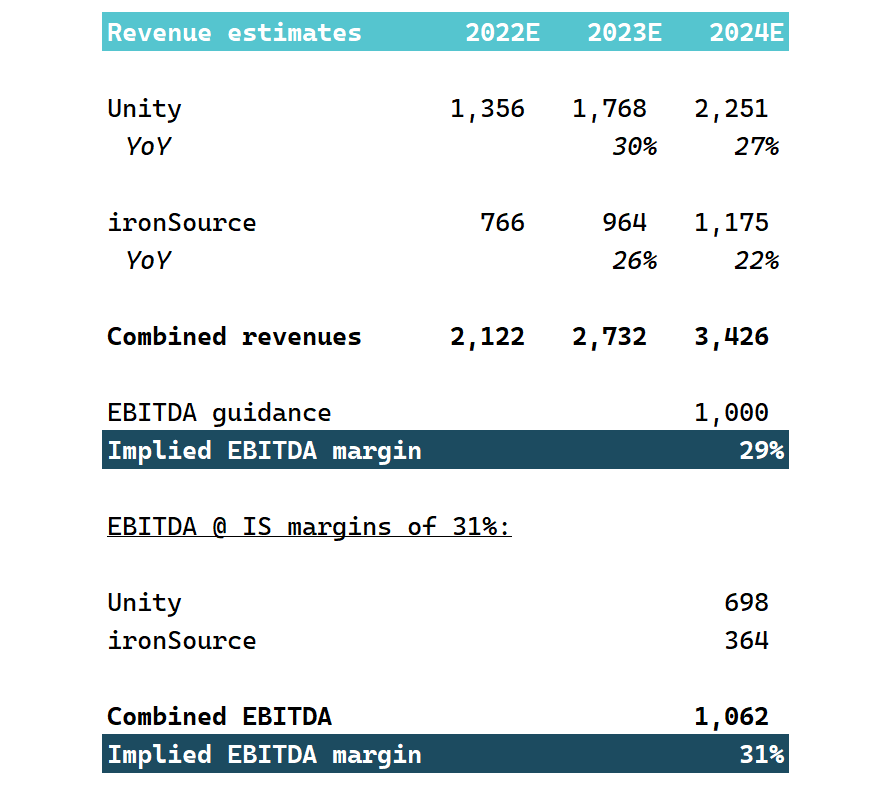
We can see that the combined companies are expected to post $3.4 billion of revenue in 2024. (The difference from the $3.2 billion in yesterday’s post stems from using my internal model rather than Bloomberg estimates, but in any case, the delta is only ~6 percent.)
Recall that Unity’s current operating margins are running at -7 percent, and that in in February Unity’s CFO Luis Felipe Visoso said he expected to breakeven by 2023:
We are—we expect to make—to improve our margins by 200 basis points in 2022, to breakeven in 2023, and obviously, we'll continue to make progress to become profitable thereafter.
On Wednesday’s call announcing the deal, Unity and ironSource’s management used the word “transformative” or a variation of it, four times.
As it pertains to Unity’s “transformed” financial profile, here’s the key quote from Unity CFO Luis Felipe Visoso:
This combination—I want to go back to the combination. This combination transforms Unity's financial profile as of day one after closing into a highly profitable and cash flow-positive company. John and Tomer shared how combining the two companies generate significant synergies. They discussed three buckets.
First, more data from more diverse sources; second, a best-in-class mediation engine in LevelPlay; and third, Supersonic, a game launch optimization engine. In addition, we expect the combined company to unlock significant cost synergies that will start in the first year and scale over time.
We anticipate over $300 million in annual EBITDA synergies by year 3, and we expect a $1 billion in adjusted EBITDA run rate at the end of 2024, which will continue to expand thereafter.
Visoso is telling investors that between 2022 and 2023 Unity’s margins will improve 200 basis points. That would result in operating margins of approximately -5 percent.
Yet his guidance of $1 billion of EBITDA by the end of 2024 only works if Unity reaches ironSource’s margins by then. From the image above we can see that the combined companies should generate exactly $1 billion of EBITDA if they generate a 29 percent EBITDA margin together. If they were to generate ironSource’s current EBITDA margin of 31 percent, we’d get essentially the same result.
Visoso is therefore implicitly saying that Unity’s margins will improve 200 basis points in 2022, and then a whopping 3,000 basis points between 2023 and 2024 (from breakeven to ~30 percent).
This—to put it mildly—strains credulity. Unity’s management is using this merger as a magic wand that will somehow whip Unity into financial fitness and allow it to accomplish feats of margin expansion that were previously unattainable.
Perhaps there are indeed substantial synergies to be had from the merger. “Synergy” is frequently used in merger discussions as a euphemism for “layoffs.” The word “synergy” was used 22 times on the call.
That’s a lot of synergy! Silicon Valley companies have been very reluctant to lay off employees in the past, and as a result have become bloated.
Meta’s recent memo about getting rid of underperformers is a rare example of tech companies being disciplined on staffing. Then, one week ago, Meta’s head of remote presence and engineering Maher Saba used stronger language about weeding out underperformers:
“If a direct report is coasting or a low performer, they are not who we need; they are failing this company,” Mr. Saba wrote. “As a manager, you cannot allow someone to be net neutral or negative for Meta.”
Perhaps this is the medicine Unity’s management team has in mind. But if that’s the case, they gave little indication of it in the merger call. And given this management team’s repeated missteps, it’s hard to take their margin guidance as anything other than wishful thinking.
Unity’s Leadership
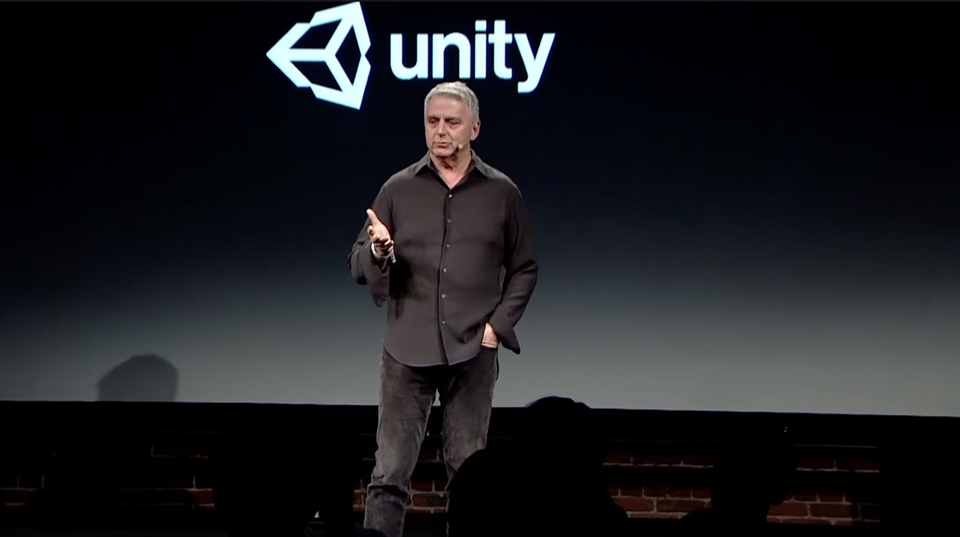
Yesterday I also wondered whether Unity’s leadership should change:
One wonders: is Unity under Riccitiello an example of Microsoft under Ballmer, i.e., a fundamentally strong business led by a leader who won’t be able to create value?
It is notable that the senior leaders of ironSource are not only taking all equity in the deal, but are also joining Unity’s leadership ranks.
Is this a backdoor way of transitioning the CEO role to an ironSource exec?
After the deal was announced, Tae Kim, a reporter for Barron’s who’s been following the gaming industry and Riccitiello for many years, wrote a column in which he noted problems in Unity’s recent acquisitions (such as the $1.6 billion purchase of Weta Digital without any tangible financial justification given to shareholders) as well as Riccitiello’s history at Electronic Arts:
After a series of questionable decisions, [Unity’s] credibility with shareholders seems to be fading.
[…]
One of Riccitiello’s first moves at EA was to buy a $167 million stake in Chinese online game operator The9 Ltd. (NCTY). The company’s share price fell by more than 90% in the ensuing years. Riccitiello also made the expensive decision to compete in the online subscription multiplayer market against World of Warcraft, which fizzled. He also acquired numerous gaming studios—including Playfish, PopCap, and Pandemic—all of which were at least partially shut down years later by EA.
Then, in a long tweetstorm, Kim elaborated on these points and posted a number of screenshots of disgruntled developers who, impatient with Unity’s repeated missteps and what they perceive as a lack of focus, plan on switching their game engine to Unity’s rival Unreal. Game developers on gaming forum Resetera also voiced their concerns over the merger.
Some developers pointed out that ironSource used to be the purveyor of malware, although the company apparently pivoted away from that practice in 2015.
It’s hard to know how much of this is actual signal versus noise, but it’s hardly reassuring.
Unity’s Board
Unity was co-founded in Copenhagen by Nicholas Francis, Joachim Ante, and David Helgason in 2004.
In 2014 Helgason was Unity’s CEO, but he decided to step down and hand the baton to John Riccitiello, who had been on Unity’s board of directors at Helgason’s invitation the year before.
Helgason wrote in a blog post at the time:
That’s why today, I’m pleased to welcome John Riccitiello onto the Unity team as our new CEO. Sure, that sounds odd, as it also means I’m stepping down from the role, but this is an amazing win for Unity and the community.
He’s the right person to help guide the company to the mission that we set out for ourselves over a decade ago: democratize game development!
Helgason remains on Unity’s board of directors and as of the latest proxy, is shown to own over 9 million shares of Unity, or 3.1 percent of the company. Co-founder Joachim Ante, who is shown as owning 18.5 million shares, is still listed as Chief Technology Officer on Unity’s website.
If Riccitiello’s recent moves are blunders, one would think that co-founders with a substantial stake and seats on the board would reign him in. But that’s not what happens. Microsoft, after all, repeatedly allowed Ballmer to incinerate shareholder capital with serial misses, even as co-founder Bill Gates was on the company’s board.
Here's a partial list of Ballmer’s mistakes:
- Acquired smartphone maker Danger for $500 million and subsequently shut it down
- Acquired digital marketing company aQuantive for $6.2 billion, then wrote off the entire purchase after five years
- Took a $900 million write-off on Surface RT
- Spent over $7 billion to acquire Nokia’s smartphone business, another deal that came undone
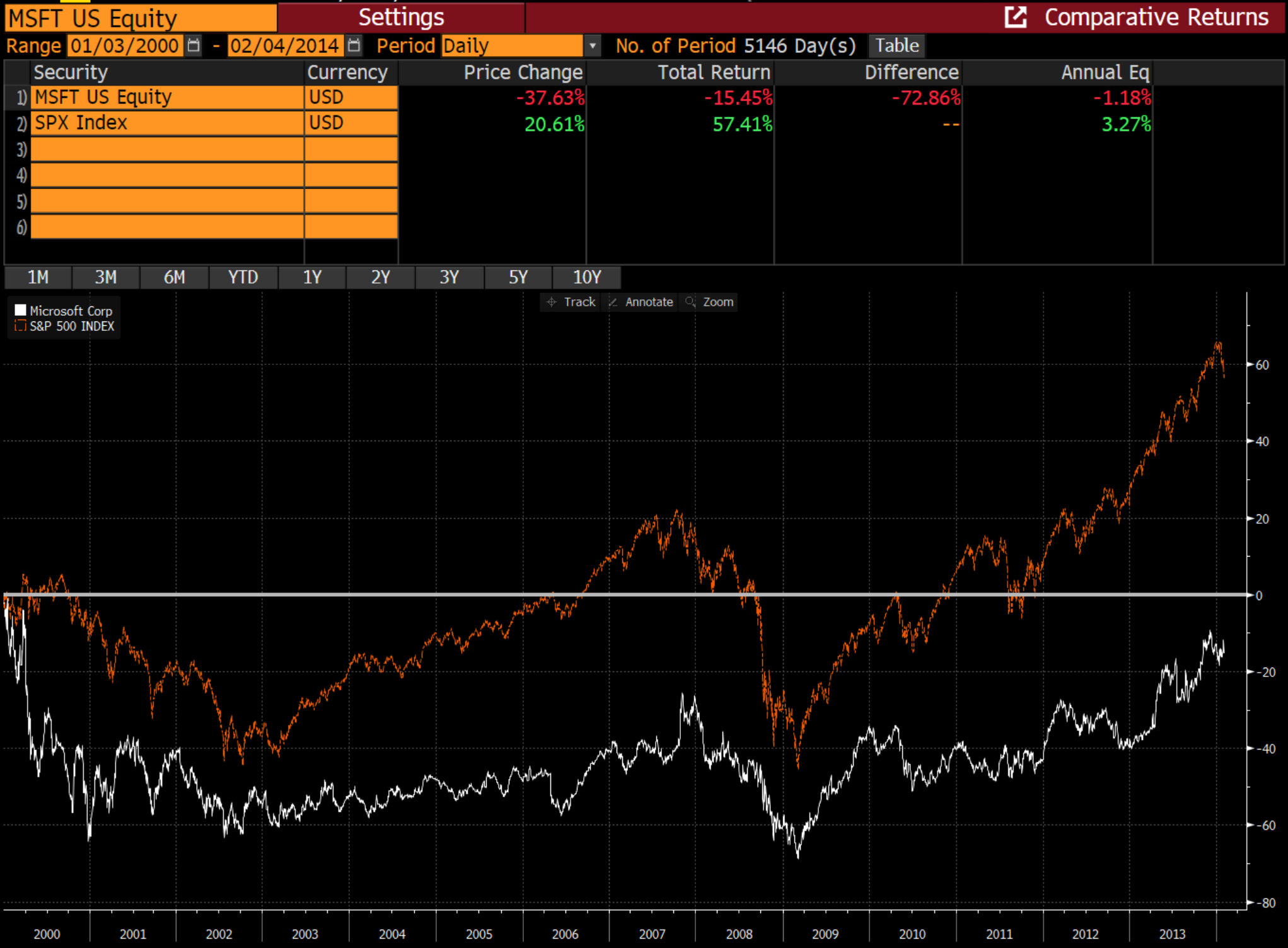
During Ballmer’s long 14-year tenure, Microsoft stock delivered a total return of negative 15.5 percent including dividends, compared with 57.4 percent for the S&P 500 index:
Ballmer was replaced on February 4th by Satya Nadella. Microsoft stock had already been anticipating the leadership change, as early as August 2013:
Microsoft's shares are up significantly in early trading on Friday following news of CEO Steve Ballmer's impending retirement.
Microsoft's shares were up as much as 8 percent on Friday, landing at more than $35 per share before easing off a bit. As of this writing, Microsoft's shares are up more than 7 percent to $34.86.
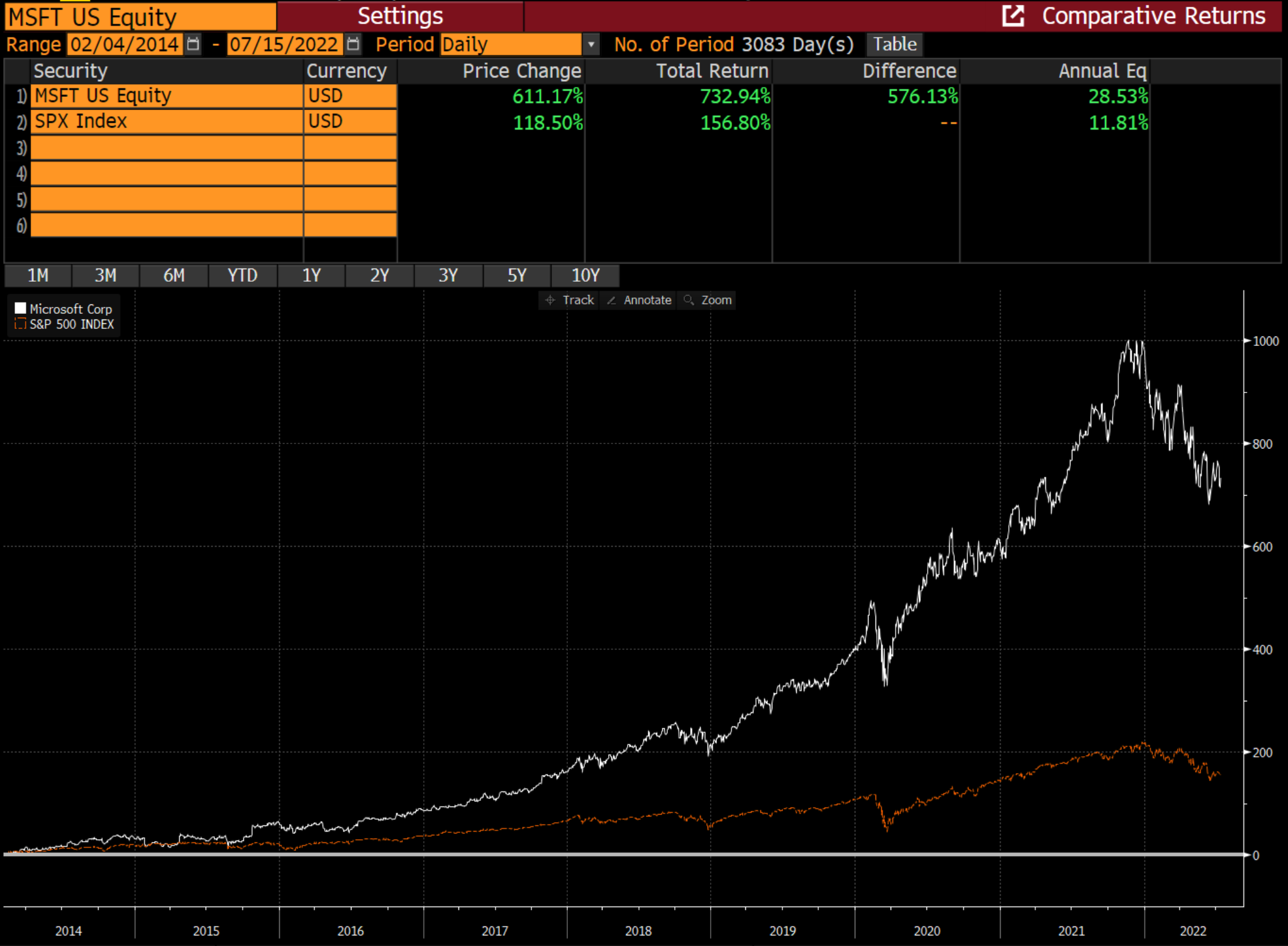
Since Nadella took over, Microsoft stock has crushed the S&P 500, delivering a total return of 733 percent compared with 157 percent for the index:
During John Riccitiello’s last tenure as CEO, at Electronic Arts, the company’s stock delivered a total return of negative 64 percent compared with 24 percent for the S&P 500:
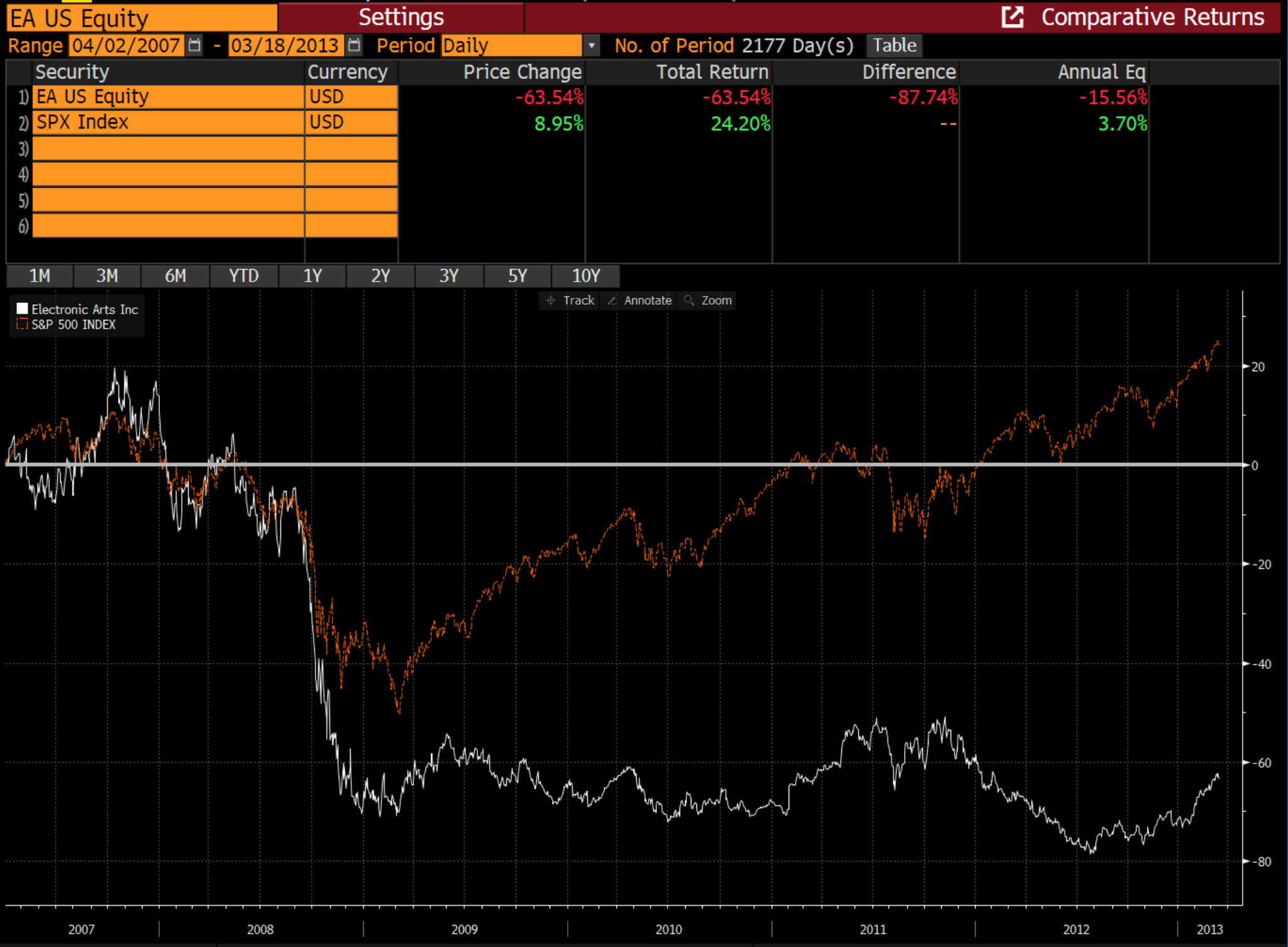
Riccitiello had been appointed CEO of Electronic Arts on April 2, 2007, and resigned in March 2013 and wrote in a letter to the board:
This is a tough decision, but it all comes down to accountability. The progress EA has made on transitioning to digital games and services is something I’m extremely proud of. However, it currently looks like we will come in at the low end of, or slightly below, the financial guidance we issued in January, and we have fallen short of the internal operating plan we set one year ago. EA’s shareholders and employees expect better and I am accountable for the miss.
Riccitiello’s tenure at EA lasted six years; he’s now been at Unity for nearly eight years. The list of errors is growing long. We noted a few yesterday and others today: problems with infrastructure reminiscent of those during his tenure at EA; questionable acquisitions; and falling short of internal operating plans, exactly what led to his resignation from EA.
Perhaps a leadership change is what Unity needs for developers, employees and shareholders to regain confidence in the direction of the company. How long will it take for Unity’s board to act?