Unity + ironSource: A Look at the Deal

Yesterday, Unity announced the acquisition of ironSource in an all-stock deal. Unity is a game engine with a dominant position in mobile and VR.
Years ago, Zuckerberg wrote a memo outlining the strategic value of Unity (to learn more about Unity and see the memo, check out this post).
IronSource is an important part of the gaming value chain. Once game developers have created their game, they must monetize. To do this, they use in-game purchases, sell ads, and acquire users. All of this requires data and an ad network. IronSource has both, and the merger with Unity strengthens their mutual capabilities.
At the time of ironSource’s public listing, the company share a slide deck that showed the company’s position in the value chain:
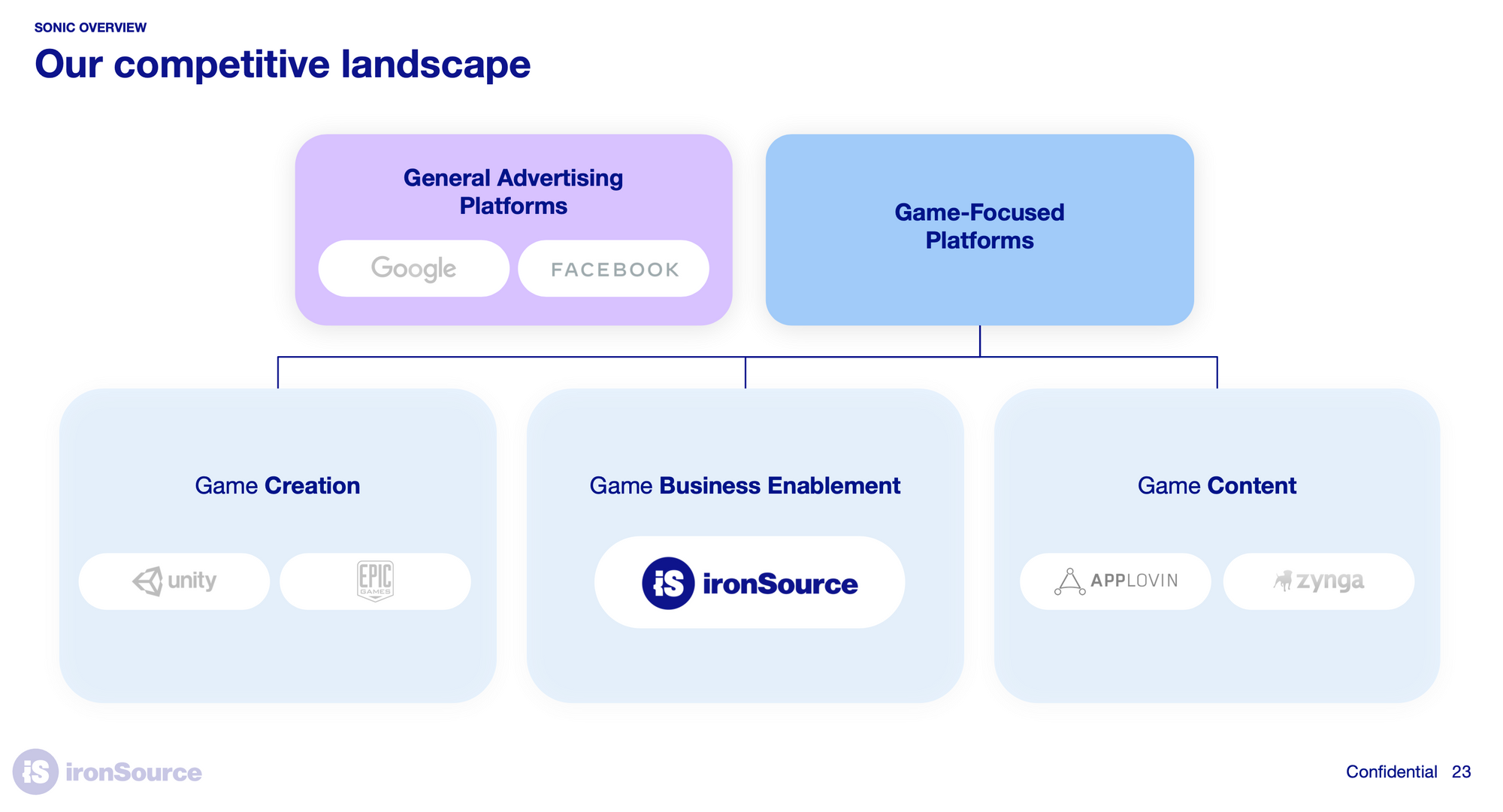
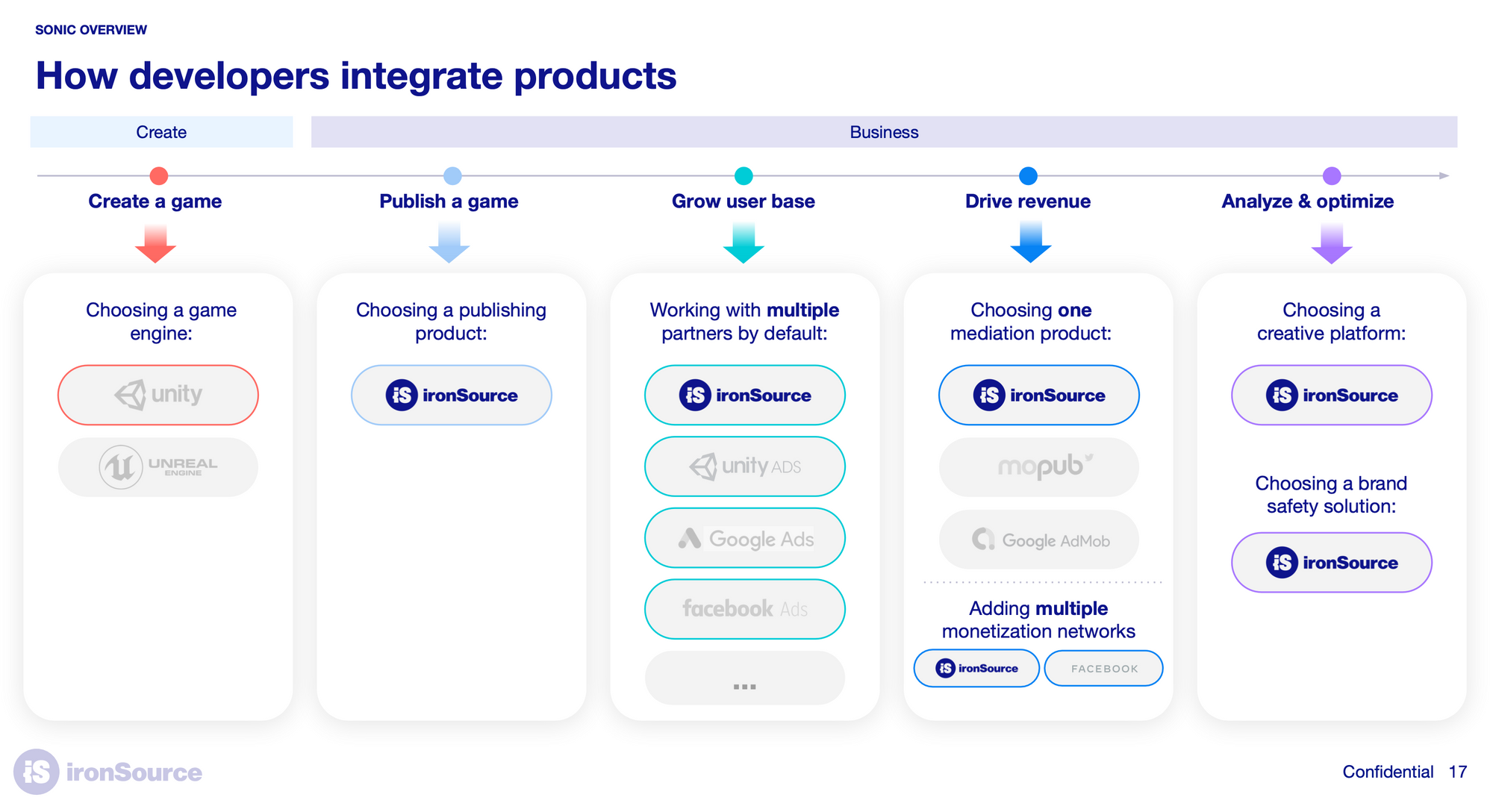
It’s that fourth column, “Drive revenue,” that interests Unity the most. The Mediation product, which allows developers to programmatically choose their ad network, is something Unity had planned on introducing. This acquisition cuts that development time and accelerates Unity’s roadmap.
Financial Merits of ironSource
Financially, ironSource is one of the most compelling businesses I’ve seen, and I wish I had known about it sooner. The fact that it went public via SPAC did not help; the vast majority of the SPAC cohort consists of bad businesses (the term of art is “shitco”); ironSource seems to be a rare exception.
The company has not only very strong net dollar retention rates averaging 157 percent over the last 10 quarters, but it also has a gross retention of 99 percent. I don’t think I’ve seen that combination in any business so far.
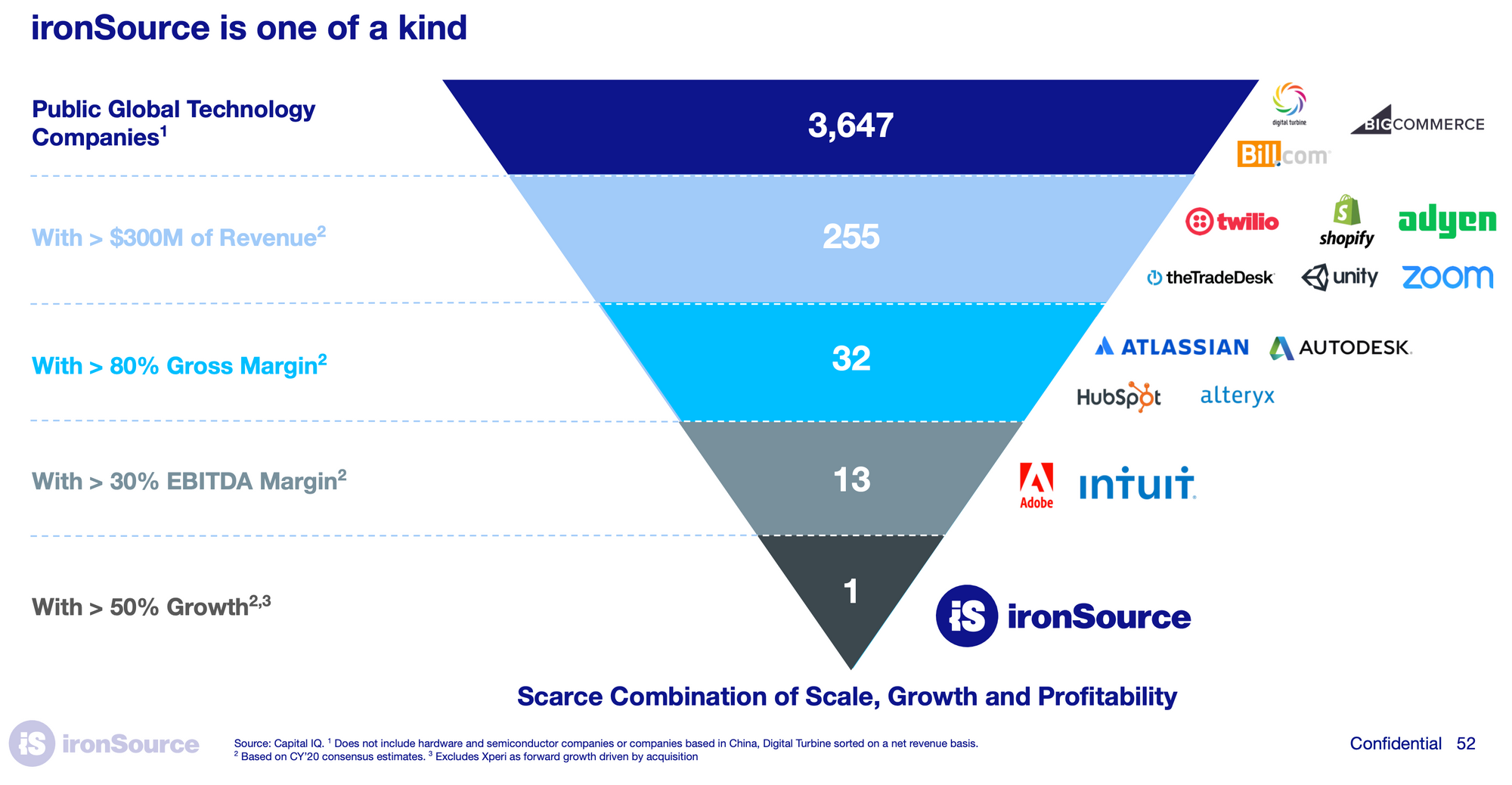
But it gets better. IronSource is also massively profitable, with adjusted (that is, before stock-based compensation) EBITDA margins north of 30 percent. It delivered a free cash flow margin of 25 percent in the last fiscal year.
This isn’t lost on ironSource, of course; here’s the bragging slide, from the time of the SPAC deal:
To top it all off, ironSource was available to Unity for a song. Before the deal was announced, the stock was at $2.23 per share. Assuming ironSource could deliver on that 25 percent free cash flow margin again this year, it was trading at only 11x free cash flow and 3.4x revenues.
The SPAC sponsors, in fact, underwrote the deal at $10 last year, with an implied enterprise value of $10.8 billion. Thoma Bravo invested $300m into the deal, at an implied multiple of 20x 2021 revenues and 14x 2022 estimated revenues.
At the current, post-deal stock price of $3.28, ironSource is going for 18x earnings. Not bad for a business expected to grow top line 38 percent this year and 30 percent next year.
From Unity’s perspective the deal appears to be a very well-timed coup.
But what about Unity’s shareholders?
Unity’s Challenges
One strange aspect of this deal is that two of Unity’s largest shareholders are getting a sweet deal. Silver Lake and Sequoia are investing an additional $1 billion in the form of a convertible that pays 2% interest and converts at $48.89.
Except Unity doesn’t need the cash. So why dilute shareholders beyond the dilution from the ironSource deal?
The $48.89 conversion price is a 49 percent premium from Unity’s current share price, but it’s also a price shareholders saw just over two months ago just before Unity’s disastrous first quarter earnings report.
One particular part of that earnings disaster sticks out. Unity had a self-inflicted wound; its infrastructure was not set up properly, and they lost customer data, then ingested bad data. The result was a $110m headwind to revenues. The impact was a stock decline that wiped out $6 billion in market value, a 34 percent wipeout.
Opening that May earnings call, CEO John Riccitiello said:
The most succinct framing for the challenges we are facing is that we built more for growth and less for resiliency. Following years of rapid growth and working through the challenges of Apple's privacy changes, we got hit hard by 2 issues. The first was a fault in our platform that resulted in reduced accuracy for our Audience Pinpointer tool, a revenue-expensive issue given that our Pinpointer tool experienced significant growth post the IDFA changes.
The second is that we lost the value of a portion of our data -- training data, due in part to us ingesting bad data from a large customer. We estimate the impact to our business of approximately $110 million in 2022 with no carryover impact to 2023. Luis will provide a more granular update to our guidance in a few minutes.
This is reminiscent of another episode involving Riccitiello. Back when he was CEO of Electronic Arts, the company launched SimCity. Its launched was botched by… its infrastructure not being set up properly (at 1:15):
I’ve been corresponding with a tech journalist who has followed Riccitiello for many years and he has given me many examples of poor capital allocation. Then there are some other allegations.
One wonders: is Unity under Riccitiello an example of Microsoft under Ballmer, i.e., a fundamentally strong business led by a leader who won’t be able to create value?
It is notable that the senior leaders of ironSource are not only taking all equity in the deal, but are also joining Unity’s leadership ranks.
Is this a backdoor way of transitioning the CEO role to an ironSource exec?
Another puzzling aspect of Unity’s May call was that Unity seemed to “find” $100m in savings in a throwaway line during the call. And then, a month and a half later, the company announced hundreds of layoffs. Yesterday, announcing the deal with ironSource, Unity once again lowered revenue guidance for the full year, further impaling its credibility. The lowered guidance is “100% driven by our monetization business” (the same business that had the infrastructure issue last quarter).
Margin Targets
When Unity went public, its IPO video showed an operating margin target of over 20 percent:
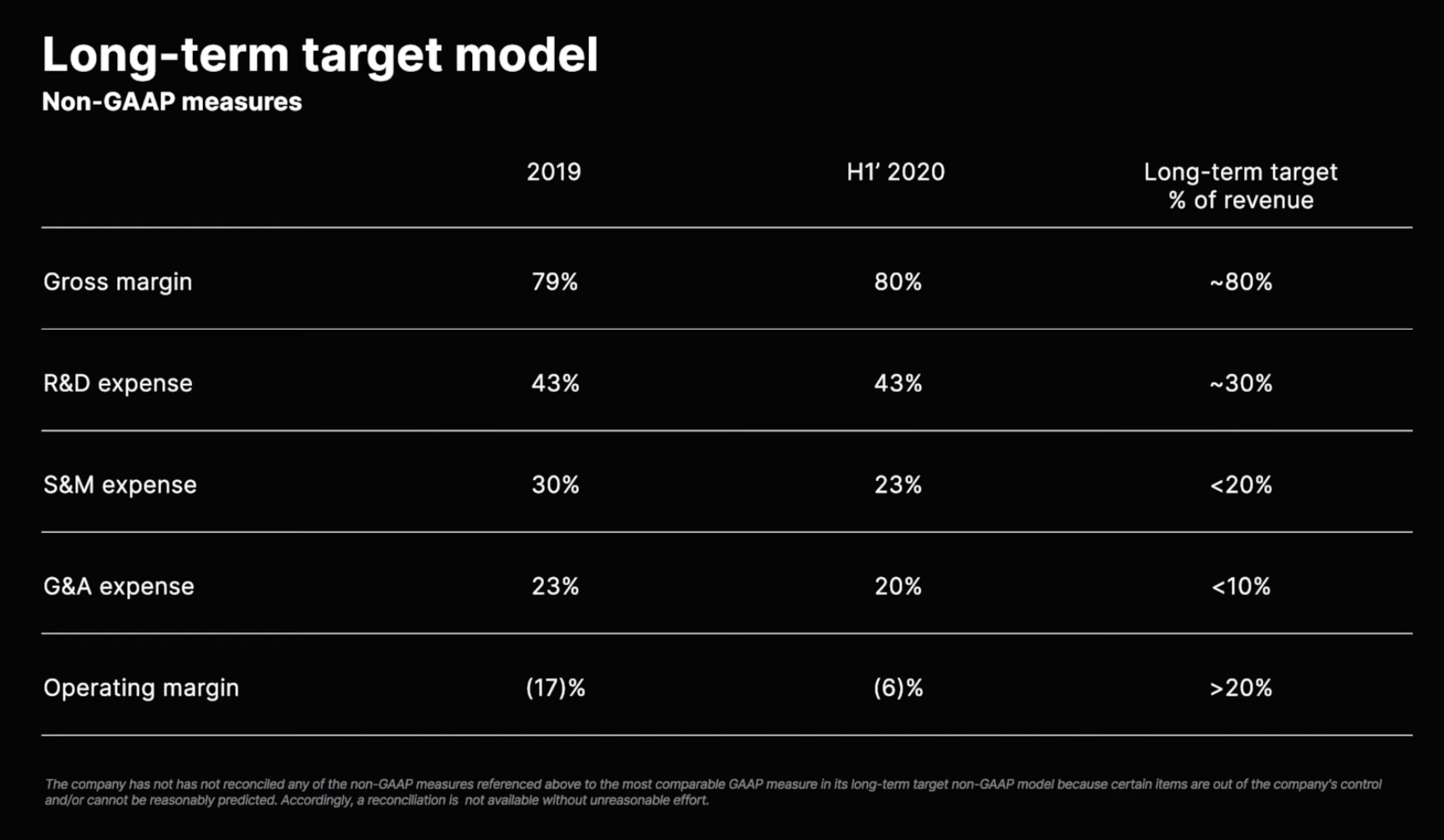
Unity is slowly increasing its operating margins. Currently, it runs at about -7 percent. Recently, Unity has said it expects to “breakeven” in 2023. From the Q4 earnings call in February:
So what can you expect from Unity going forward? So in terms of revenue growth, as we just said, you can expect us to grow between 34% and 36% in 2022, and then at least 30% thereafter. So we will continue to drive that—this driver, which is critical for us. At the same time, we'll continue to make progress on non-GAAP operating margin. We are—we expect to make—to improve our margins by 200 basis points in 2022, to breakeven in 2023, and obviously, we'll continue to make progress to become profitable thereafter.
Two points to call out: “you can expect us to grow between 34% and 36% in 2022” became “we will grow 21%” just five months later.
At the same time, Unity said that its merger with ironSource will “enable us to achieve an adjusted EBITDA run rate of $1 billion by the end of 2024.”
The only way to achieve $1 billion of EBITDA by the end of 2024 is if Unity itself reaches ironSource-like margins by then.
This means going from “breakeven in 2023” to 31 percent operating margins by 2024. The math doesn’t work any other way. I hope Unity’s CFO realizes this.
The combined revenues of both companies will be $3.2 billion, based on current analyst expectations, and 31 percent combined operating margin gets you exactly $1 billion in EBITDA (operating income is not the same as EBITDA, but for a digital business without heavy machinery or PP&E, I’m taking the liberty of assuming depreciation and amortization will be quite low).
The question is, are these targets at all believable? Especially given the black marks on Unity’s management team over the last five months?